


Let’s be real – you’re not here because toilets are fascinating. You’re here because yours is cracked, leaking, running nonstop, or you’re knee-deep in a bathroom remodel and somebody needs to tell you what this part actually costs.
At Ben’s Plumbing, we’ve been swapping out toilets across Seattle for over 25 years. We’ve seen everything from pristine new-construction installs to 1940s cast-iron nightmares in Wallingford basements. The numbers below reflect what we’re actually quoting in 2026 – not recycled national averages, but what the job costs here, in this city, with our permitting rules and our labor market.
What Seattle Homeowners Typically Pay
The short answer: it depends on whether you’re putting a toilet where one already exists or starting from scratch. Those are two very different jobs with very different price tags.
Installing a New Toilet
The average cost to install a toilet in Seattle, where the rough-in plumbing is already in place, and you just need the unit set, sealed, and connected, runs $250 to $600. That includes labor, a new wax ring, supply line, and basic hardware.
The cost in Seattle is above the national average. Between city permits, what plumbers earn in this market, and the fun surprises that older Seattle homes like to hide, that’s just the reality.
Here’s what that price range looks like in practice:
| Scenario | Typical Cost |
|---|---|
| Basic fixture install (builder-grade unit, existing rough-in) | $250 – $400 |
| Mid-range toilet install (comfort height, elongated bowl) | $350 – $500 |
| High-end toilet install (one-piece, wall-hung, or specialty) | $450 – $600+ |
These numbers are labor only. The fixture itself is separate – budget $150 to $500 for a solid residential model, or significantly more for premium brands.
Replacing an Existing Toilet
Toilet replacement cost in Seattle typically runs $300 to $700 when you’re swapping an old unit for a new one in the same location. The job includes disconnecting and removing the existing fixture, inspecting the flange and floor, installing the new unit, and testing everything.
So how much does a plumber charge to replace a toilet when it’s a straightforward swap? You’ll typically land between $250 and $400 for labor alone, assuming no hidden damage under the old unit.
The surprises are what push costs higher. A corroded flange, water damage to the subfloor, or a non-standard rough-in distance can each add $100 to $400 to the final bill. We’ll get into those details below.
Costs of Relocating or Adding a Toilet
This is where the numbers jump – and where planning ahead saves real money.
Relocating the Drain or Plumbing Line
Relocating the fixture even a few feet means moving the drain line, and that’s a bigger job than most people expect. You’re typically looking at $1,500 to $6,000+, depending on access, slab work, and rerouting complexity.
In Seattle homes with crawl spaces, this work is more accessible – and therefore cheaper – than in slab-on-grade construction. If your bathroom sits over a concrete slab, expect costs toward the higher end because the concrete needs to be cut and repoured.
Adding a Toilet to a New Space
Converting a closet into a half bath? Finishing a basement? Adding a new fixture where none existed before means running new supply and drain lines from scratch.
The total bathroom toilet installation cost for a new space typically runs $2,500 to $6,000+, broken down roughly as:
- New drain line and vent: $1,000 – $3,000
- Supply line and shut-off valve: $200 – $500
- Toilet purchase and installation: $400 – $1,000
- Permits (Seattle requires them for new plumbing): typically $300 – $800, depending on scope and valuation.
The biggest variable is distance from existing plumbing. A basement bathroom directly below an existing bathroom is the easiest scenario. A new half bath on the opposite side of the house is the most expensive.
What Can Increase the Final Price?
The base toilet installation cost is only part of the picture. Several factors can push your total higher – some predictable, some not.
Toilet Type: Standard, Smart, or Bidet
Your choice of model has a direct impact on installation complexity and cost.
A standard two-piece model is the simplest and cheapest to install. A wall-hung toilet requires a carrier frame inside the wall – that alone adds $300 to $800 in labor and materials.
Smart toilet installation cost climbs because these units require a GFCI-protected electrical outlet nearby, and most Seattle bathrooms weren’t built with one. Running a new circuit typically adds $300 to $800, depending on how far your electrical panel is from the bathroom.
Bidet toilet installation cost depends entirely on the type. An integrated bidet toilet – something like a TOTO Washlet+ combo – installs much like a standard unit but still needs that electrical connection. A standalone bidet next to the toilet? That’s a separate fixture with its own supply and drain connections, which roughly doubles the plumbing work.
| Toilet Type | Install Labor | Additional Requirements |
|---|---|---|
| Standard two-piece | $250 – $400 | None |
| One-piece | $300 – $450 | Heavier; may need two people |
| Wall-hung | $800 – $1,500 | In-wall carrier frame |
| Smart toilet | $400 – $700 | Electrical outlet |
| Bidet combo | $400 – $700 | Electrical outlet |
| Standalone bidet | $500 – $900 | Separate drain and supply connections required |
Removal, Disposal, and Basic Repairs
Every replacement job starts with removing the old unit. Most plumbers include removal in their prices, but disposal is sometimes extra – typically $55 to $100 to haul the old unit away.
What we find underneath the old toilet matters more. Water damage around the base is common in Seattle’s older homes, especially where slow leaks have gone unnoticed for years. Replacing rotted subfloor or damaged flooring around the toilet base adds $200 to $600, depending on the extent of the damage.
Rough-In Work and Drain Line Adjustments
The “rough-in” measurement – the distance from the wall to the center of the drain – is critical. Most toilets are designed for a 12-inch rough-in. Older Seattle homes sometimes have 10-inch or 14-inch rough-ins.
If your new toilet doesn’t match the existing rough-in, the plumber either needs to find a toilet that fits (limited selection) or adjust the drain line ($300 – $800). This is one of those things a good plumber checks before you buy the toilet, not after.
When Is It Better to Repair Instead of Replace?
Not every toilet problem requires a new toilet. Some of the most common issues are straightforward repairs that cost a fraction of a full replacement.
Flange, Wax Ring, and Seal Issues
A toilet that rocks on the floor, leaks around the base, or sends sewer gas wafting into the bathroom almost always has a flange or seal problem – not a toilet problem.
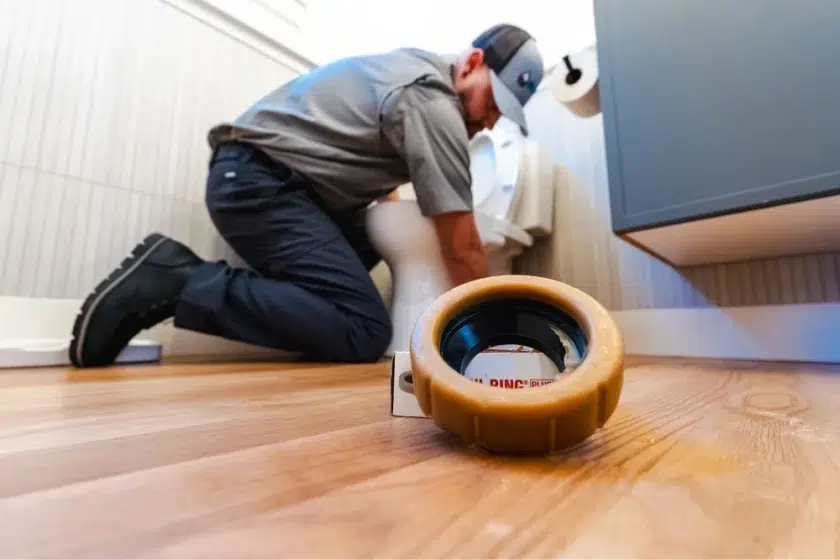
How much to change a wax ring on a toilet? In Seattle, expect to pay $150 to $300. The plumber needs to remove the toilet, scrape the old ring, set a new one, and reinstall. It’s a couple of hours of work and one of the most common repairs we do.
The cost to install a toilet flange – or swap out a broken one – runs $200 to $400. Flanges that are corroded, cracked, or sitting too low (which happens a lot when new flooring gets laid over the original) need to be replaced or extended before anything will seal right.
Tank Components and Water Valves
A running toilet is usually a $100 – $250 fix. The toilet fill valve replacement cost falls in the $100 – $200 range, parts included. It’s one of the simplest repairs in plumbing – the valve lifts out and the new one drops in.
Toilet gasket replacement cost – the seal between the tank and bowl on a two-piece toilet – runs $120 to $250. If your toilet leaks where the tank meets the bowl, this is almost always the culprit.
Other common component repairs:
- Flapper replacement: $75 – $150
- Handle and flush lever: $75 – $150
- Supply line replacement: $75 – $150
- Shut-off valve replacement: $150 – $300
When Repair Makes More Financial Sense
Here’s our rule of thumb after 25 years of doing this: if the toilet is less than 10 years old and the porcelain isn’t cracked, repair it. If you’re facing a $400+ repair on a 20-year-old toilet that uses 3.5 gallons per flush, replace it. A modern 1.28 GPF toilet can reduce water usage significantly and may offset part of its cost over time, depending on household size and water rates.
Also worth replacing: any toilet with visible hairline cracks in the tank or bowl. Those cracks only get worse, and a cracked tank can fail suddenly – dumping gallons of water onto your bathroom floor with zero warning.
What a Plumber Will Check During an On-Site Visit
When we come out to quote a toilet installation or replacement, here’s what we’re actually looking at:
- Rough-in measurement. Does your new toilet match the existing drain position?
- Flange condition. Is it level, intact, and at the right height relative to the finished floor?
- Subfloor integrity. Any soft spots, water damage, or rot around the drain area?
- Supply line and shut-off valve. Are they functional, or do they need replacing while we’re here?
- Venting. Is the drain properly vented? Poor venting causes slow flushes and gurgling.
- Floor level. Is the bathroom floor even? An uneven floor requires shimming to prevent rocking and leaks.
This assessment typically takes 15 – 30 minutes, depending on access and site conditions, and helps us determine the full scope of the work.
Need a straight answer on your toilet project? Ben’s Plumbing provides on-site estimates across the Seattle area. We’ll measure, inspect, and give you a written quote before any work begins. Call us or book online – we’ve been doing this long enough to get it right the first time.